This short film , 'Operator' is based around an emergency services call centre and focuses on one particular distressing call from a mother with a young child trapped in a house fire. The call operator has to handle the call calmly and professionally whilst she talks the terrified mother.
The film starts by setting the scene with a pan shot. This shot includes ambient audio of background calls as well as dialogue of call operators take different calls. The shot pans over three different operators in a close-up. Their faces are not clearly seen and are only onscreen for a couple of seconds and have little dialogue. This is to show that they are not the main character/protagonist.
There is then a medium close-up of the main protagonist which the film focuses on throughout. We can tell that she is the visual focus by the framing used, which highlights her identity as a white women. This has connotations that she would be more sensitive to a distressing situation than a male character and may be more comforting to the woman on the phone. The audience can hear the yelling of the mother on the phone and the dialogue between the two characters, as well as ambient sound. Sound is important within this short film as it indicates the storyline as we can only see the one setting.
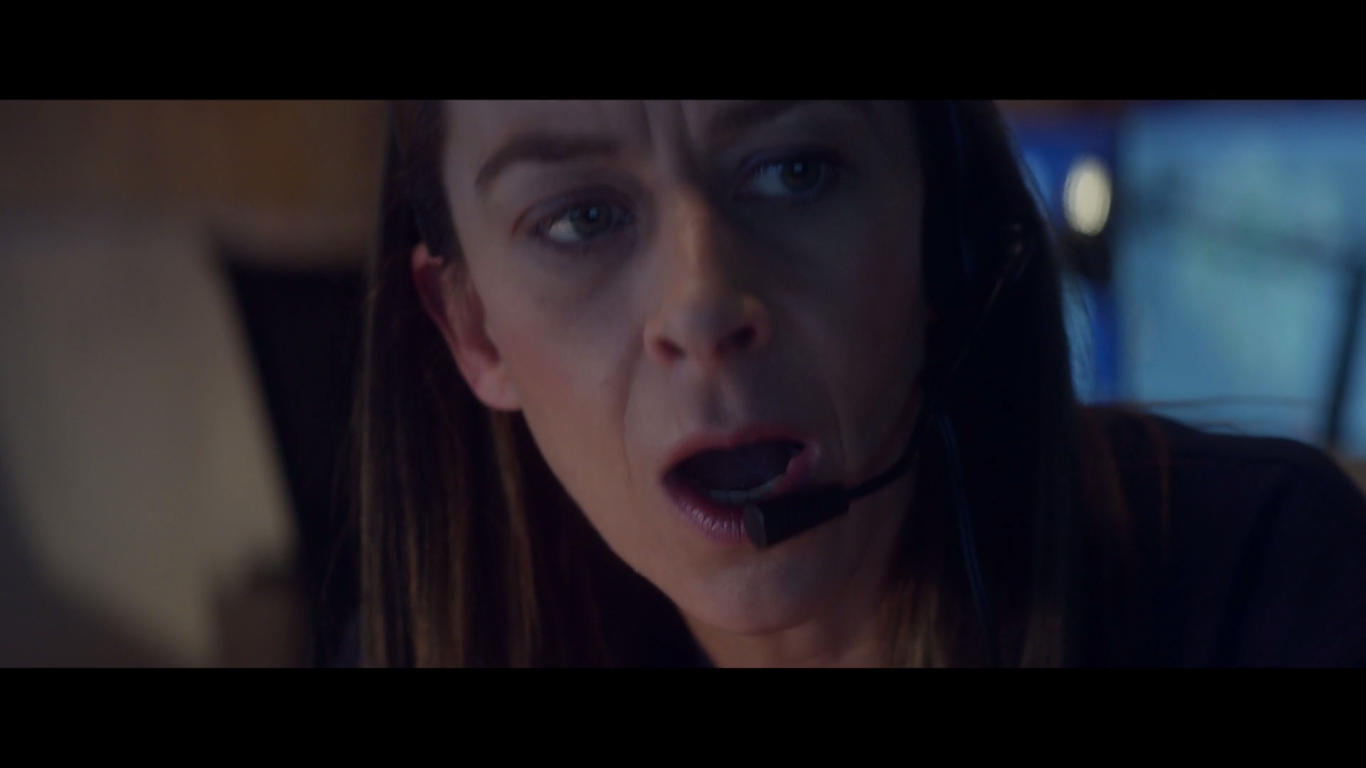
The setting is dark with the majority of the light coming from the computer screens which creates harsh lighting on the protagonists face. This has connotations of a serious situation when knowing the context; the woman on the phone is in a house fire and is separated from her three year old son. There is also a close-up on the operators face, increasing the severity of the situation, shown by the expression of concentration. We can tell the protagonists profession, not only by her dialogue, but also by her uniform and headset. Call operators have the headsets so that they can have their hands free to use their computers. This shows that the filmmakers have thought a lot about the mise-en-scene to make the film realistic.
The shots in the film are long an range between close-ups, medium close-ups and minor pans. However, these are all centralised around the main character. By doing this, the audiences attention is kept on the one situation. This contrasts the the opening of the film where there are more ambient audio which was used to create atmosphere.
The audio on the phone is critical for the audience's understanding of the situation. There are sounds such as burning fire, cough, sirens and smashing glass. All these sounds, in an order that fits with the narrative, show the progression of the character Gemma's struggle to get out of her house safe. A there is now visual at the scene, the audience relies on this audio to understand what is happening.
At the end of the film, there is a click signifying the end of the phone call and a close-up of the operator. She is shown to be a bit shaken but because of her profession, she calmly takes the next call. This is important as it shows that Gemma's situation is not the only distressing call the operator will deal with that day, highlighting the importance of our emergency services.
This song by Lady Gaga was popular during her prime in the music industry. Her music videos were extremely lavish and over-the-top as to put a point across. These messages normally link to inequality of women and how the media industry supports this. In this particular music video, and partly the song, the message portrayed is that the media will do anything for a good story. She uses vintage glamour to exaggerate the violence towards the women in the video and how women are expected to be seen in the media.
The video is set in and around a large white mansion, possibly in the Mediterranean, which gives the audience the impression that whoever is staying there is wealthy. This is further supported by the scattering of money and jewels inside the mansion. The money has Lady Gaga's face on it, much like the monarch has their face on currency. This shows that Gaga is the one who has the most fame out of the two people in the mansion. It also shows that she feels she is highly important and has power as she is printing her own money, therefore branding herself.
There is a lot of promotion for the Gaga brand throughout the music video. Most branding in the video relates to her jewellery and Dior jewellery as she wears rings that spell "Dior" and then there are several close-ups of her own jewellery, like jewels with the letter "G" for "Gaga" on them.
The entire video is themed in a mix of vintage and modern glamour. The Italian style decor and the costumes the characters are wearing, especially at the start of the video, are more like the attire wealthy people would wear in the 1950's. Gaga is wearing a white corset which has several connotations. The colour white could suggest her innocence before the start of her revenge. It makes her seem like the damsel in the scenario. The fact that she is wearing a corset is very sexualised which portrays women as sexual objects. It also shows how women, especially in the media, are restricted and shaped to look a certain way. They are expected to have the perfect appearance which can bring suffering.
During the first scene, there are calm sounds of birds and waves. Not only does this set the scene for the location, it also creates a false sense of security before the conflict happens, indicated by the start of the song. This is also linked to the colour scheme used in the first scene. The use of light colours represents peace and calm, which highly contrasts to the rest of the video when the music starts where the colour scheme is darker and more sinister.
Another way we can tell that there is a vintage theme behind the video is the font of the titles and credits. The font suggests there is inspiration from the film noir genre. By having this type of font, we can tell straight from the beginning that the video is going to be a narrative and that it is going to involve some sort of criminal activity as that is typical of the film noir genre.
The act of the male character throwing Gaga off the balcony shows the change in control and power. Not only does this suggest that men control women, it shows a shift in the power and a change in their relationship. This will be the act that will motivate Gaga for her revenge at the end of the video.
Before the male character pushes her off the balcony, there are vintage styled snap shots taken as if in secret, suggesting the paparazzi. The black and white shots link in with the old-fashioned newspapers that flash onto the screen with headlines about Gaga. This is a way of continuing the vintage theme. Gaga may have made the vintage theme more prominent in the beginning to exaggerate the change in time from the beginning to the end, to represent how attitudes towards females and their role in society is changing.
We first see Gaga lying on the floor below the balcony, draped in pearls and diamonds. However, there is no blood but red glitter. This has been done to glamorise her trauma because she is a woman in the media; she needs to look presentable at all times. This is continued when there are images of dead models, made to look like they've been murder or committed suicide. By making such difficult issues into a glamorised statement, Gaga has shown that the paparazzi and the media are only concerned with getting a gripping story and have no concern for the victim. This is shown by the way the photographers crowd around Gaga's mangled body.
When the song starts, we first see Gaga in a neck brace and in a wheelchair, being carried into the mansion by butlers. This part of the music video shows Gaga's recovery from her fall, showing in a wheelchair, then on crutches, then as she was before. This could be quite controversial for disabled people because it glamorises disability by still continuing the theme of wealth and fame. It could be perceived as disrespectful because of all the diamonds and jewels surrounding her. However, I think Gaga's message at this point is to say that people that are disabled can be glamorous like anyone else.
Between the second scene and the next, there is a money transition. The transition shows dollar bills with Gaga's face on, much like the dollar bills that were scattered around the mansion. This shows that there has been a change with Gaga's condition. It suggests that she is gaining back her power and wealth. From here, we know that Gaga will now bring back her fame in some way.
Gaga does several hand gestures but the gun gestures are significant. They suggest aggression and violence that will lead to murder. These gestures, along with the dead women, make it clear that Gaga is going to be directly involved in whatever is going to happen next. The underline message could be that women don't have to always be innocent and non-violent just because that is what is expected of them in the media.
In the last scene, Gaga's outfit and the attire of the male character have major significance. The male character is wearing the same style clothes as he was wearing at the start of the video, which suggests that he hasn't changed in his opinions against women. However, Gaga is wearing a yellow jumpsuit with an unusual pattern as the print. It is of Gaga's face with a helmet with mickey mouse ears. This makes something innocent into something violent, much like Gaga after her fall. Her change in style shows that she is no longer the same as she was at the beginning of the video as she has gained dominance of her boyfriend.
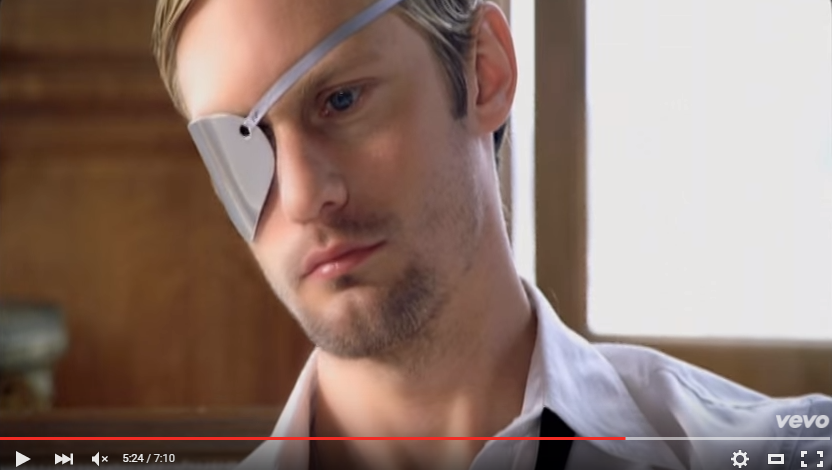
The male character is also wearing an eye-patch which could have different perceptions of what this could imply. It could be that she has hurt him physically with the champagne bottle she threw at him as self defence before he threw her off the balcony, or she could have hurt him by returning to fame, meaning his power over her has now gone. Or he could be blind to her plan to murder him.
During this scene, the two characters don't look at each other. This shows that there is distance and secrecy between them. By not looking at each other, there is no connection. This contrasts to the start of the video where they had continuous eye-contact.
Gaga then goes to make a drink. The colour of the drink is red with connotes danger, passion and death. It symbolises her anger over what he did and makes the audience think that this will kill him. This is further supported by the fact that she adds a powder from her ring. The use of the ring to store the poison shows her status and power over him as she has control over his life.
As she makes the drink, she stares at the camera, breaking the fourth wall. This includes the audience in her plan as we know what is happening and the male character doesn't. This gives the audience a share of Gaga's power as we have the knowledge of what will happen to him.
At the end of the video, Gaga is shown being taken into a police car, but instead of wanting to hide, she embraces the cameras. This shows her as having all her fame back and she wants the media to see her even though she is now a criminal. This shows the change of opinion that women are innocent.
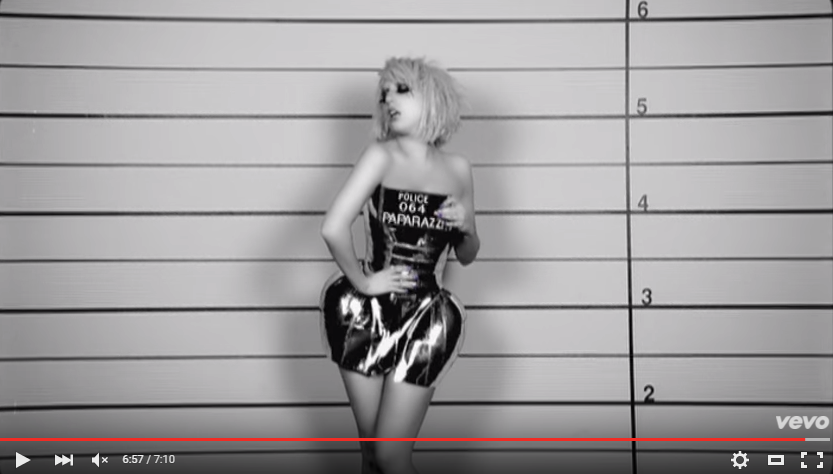
She then has her photograph taken at the police station. She uses this opportunity to pose, as if she was at a fashion shoot. This shows that she doesn't care how she is seen. The underlying message could be that women should still be glamorous in any situation according to the media.
The term "short film" refers to a film with the maximum length of 40 minutes. Unlike a feature film, short films do not necessarily have to follow the three-act structure but shots are normally thought over to create the same emotion as a feature length film. Short films are made by filmmakers to gain film making experience and to promote their skills for future film projects that may need a bigger budget. Budgets for short films are often low or they don't have a budget at all. They are normally non profit as they are made by independent film companies. Filmmakers can get some funding, if needed from non profit organisations, sponsors or through personal funding.
Short films started to appear in cinemas around the 1920's. These were often comedies and animations are were part of the cinematic experience at the time. When you bought a ticket, you would watch the feature film, the newsreel and a short film as well as several other secondary films. In modern times, short films are now mostly shown at short film festivals as now, very few short films are shown in cinemas. Originating in Australia in 1993, Tropfest is now the world largest short film festival in the world and takes place across the globe. It is often said that Tropfest started the new popular interest in short film over the recent years.
The Black Hole - Future Shorts:
To introduce the title of the film, the editor decided to include a circle transition to open the film. The use of this particular transition links to the rest of the film plot as it is a reverse 'black hole' as the circle transition goes from a black screen to the open shot through a opening hole.
There is then a pan to the protagonist and the only character within the short film. The pan shows the importance of the character as the camera immediately gravitates towards him, rather than anywhere else in the setting. The setting is an office. This can be told by the props around the character and his costume. There are desks and computers in the room, as well as the photocopier. The pan then leads to a mid close-up of the protagonist, who is wearing a shirt and tie, but is scruffy which suggests that he has been at work a long time. There is a green/blue tint over the shot which suggests a dull atmosphere, which is supported by the diegetic sound a the protagonists deep sigh. This first setting can be seen as the equilibrium according to Todorov's theory of equilibrium.
Sound throughout the short film is entirely diegetic, however there is no dialogue. The sound of the photocopier and other office machinery supports the setting as being an office. The photocopier is louder than the other diegetic sounds, signifying proxemics as well as the significance of the machine. There is a close-up of the protagonist starting the photocopier, return to the mid close-up and the back to a close up of the photocopier but from a different angle. The changing of shots allows the film to show the protagonists reaction to the photocopier not working. The use of the angled close-up could symbolise the protagonists confusion on why the machine isn't working.
Once the photocopier is working, the machine prints out a black dot, shown within a close-up. Again a close-up of the protagonist's expression shows him to be confused. There is a high angle to show the protagonist. There is round black frame which signifies that the audience is looking through the black dot, implying that it possibly is not a dot, but a hole, hence the title 'The Black Holes'. There is then a high angle shot again where the protagonist looks directly into the camera, breaking the fourth wall. This creates the idea that he is looking directly at the audience, creating suspense and the audience is still unsure of what is happening at that moment and what the protagonist is actually looking at.
The audience is then shown that the implication of the dot being a hole is correct when the protagonist places his hand inside to retrieve the cup he dropped inside. This is where the audience discovers the capabilities of the hole, shown by a tracking shot to a vending machine. The protagonist then reaches through the hole into the vending machine to grab a chocolate bar. This then makes the audience wonder what he is going to do next.
The protagonist is then shown that he is getting ahead of himself when he starts retrieving money from a safe. First there is a zoom towards a door which has the sign "KEEP OUT" on it. However the protagonist ignores the sign and enters anyway. This may be because he knows what is behind the door as he works in the same area. As he enters, the audience starts to expect something to happen to the protagonist but we are not sure what it is yet. There is the a shot, framed centrally by the door frame, of the protagonist reaching through the hole inside a safe. As he gradually quickens his pace with bringing out the piles of cash from the safe, tension is built as the audience is still expecting something to happen to him. There a quick cuts showing that he is anxious to retrieve as much money as possible incase someone catches him in the act.
There is a close-up of the tape which is holding the paper in place to show it moving. This indicates to the audience that the paper could come off the safe, but doesn't confirm it. However, after a quick cut from a close-up of the tape to a framed shot of the safe, the implication is once again confirmed which shocks the audience and makes them wonder how he will get out. The cut back, showing the framed shot as a medium shot, concludes the film. The audience can hear knocking, showing that the protagonist is actually in the safe and has no way out as his escape routine has gone.