Friday, 20 November 2015
Task 10: After Effects
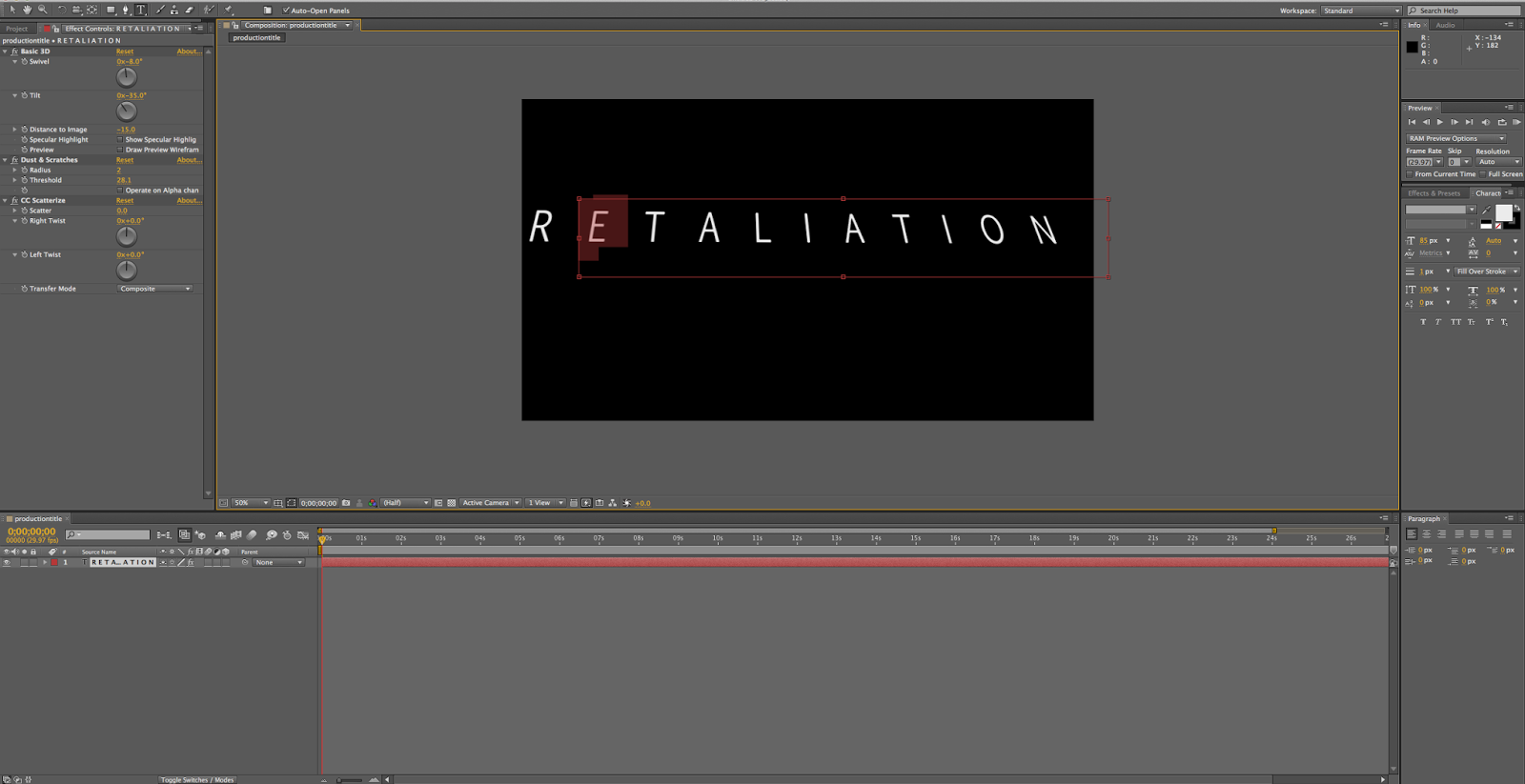
As films conventionally include the studios logos before the film, we decided to create our own. To do this we used After Effects, which is industry-standard in creating logos and compositions. Despite practicing with After Effects in AS, we found it difficult to understand and it took a while to get some ideas created. We decided to add an animated background with text that transitioned in, as we felt this was the most aesthetically pleasing. After exporting we decided to import it into Premiere, where we added a sound effect. When this was finalised we added it to the beginning of our short film.


Thursday, 19 November 2015
Task 10: Editing - Sound
As our production contained diegetic sound, we made sure that we used high quality equipment to record it. The JVC camera we used had an excellent microphone built in that was suitable.
However, even after this there was still unwanted audio in the shots, particularly the outside ones, such as the wind. There was no way I could have prevented this during the filming, however in Adobe Premiere I could add sound effects to remove the unwanted noise.
 I added a highpass filter to the outside shots so that the only sounds of a specific decibel reading can pass through. This meant that the sounds of the door opening was picked up but the wind in the background was not. As well as being more satisfying to listen too, it also helped each shot to flow, as the sound was consistent throughout, meaning that hopefully the continuous editing is unnoticeable.
We decided to overlap the audio slightly with the jump cut to emphasize the sudden change and to create tension. This was very subtle but we thought it looked a lot better than it did previously and helped the shots flow despite the jump.
After this I added soundtracks. Initially after adding the first soundtrack I felt that the ending was too abrupt. I tried to fade it out but it wasn't successful, so I decided to add an more ambient soundtrack to the end of it so that they overlapped seamlessly, and this also helped to build tension in the subsequent scene that showed the protagonist trying to find out what was outside.
Once we filmed the later parts of the film, I noticed for many of the scenes the sound was left ear only. This made it unpleasant to listen to so I decided to try and fix this in Premiere. I found out that there was an audio effect called 'fill left' which meant that the audio from the left ear was replicated on the right side. We applied this to all of the scenes.
However, even after this there was still unwanted audio in the shots, particularly the outside ones, such as the wind. There was no way I could have prevented this during the filming, however in Adobe Premiere I could add sound effects to remove the unwanted noise.
We decided to overlap the audio slightly with the jump cut to emphasize the sudden change and to create tension. This was very subtle but we thought it looked a lot better than it did previously and helped the shots flow despite the jump.
After this I added soundtracks. Initially after adding the first soundtrack I felt that the ending was too abrupt. I tried to fade it out but it wasn't successful, so I decided to add an more ambient soundtrack to the end of it so that they overlapped seamlessly, and this also helped to build tension in the subsequent scene that showed the protagonist trying to find out what was outside.
Once we filmed the later parts of the film, I noticed for many of the scenes the sound was left ear only. This made it unpleasant to listen to so I decided to try and fix this in Premiere. I found out that there was an audio effect called 'fill left' which meant that the audio from the left ear was replicated on the right side. We applied this to all of the scenes.
Wednesday, 18 November 2015
Task 10: Editing - Colour Correction
As our film is a thriller, we felt that it's darker themes meant that the colours would have to suit it. We decided to reduce the intensity of the colour, as we wanted to emphasize the protagonist's emotions of both isolation and fear. We did this by adding... We also decided to increase the contrast, as we wanted the shadows to be more harsh to unnerve the viewer.
Our film was filmed with a 16:9 aspect ratio, however after further research into the thriller genre, we found out that the conventional aspect ratio was an anamorphic 2.39:1. Therefore we decided to change it in post production.There is not a concrete method of changing aspect ratios in Premiere, but it can be done a variety of different ways. One method we looked at is cropping the video 12.5% on the top and bottom. Although this is easy to do and works effectively, it prevented us from framing the shot afterwards, and the head of the subject was often cut off. We decided to try a different method, which was to add two separate black colour matte's on the above video layers, This meant that the below layers weren't affected and, as a result, we could re-position the shot so that it contained the subject. Also, as this was in a separate layer, it could be dragged across the duration of the film, so it did not have to be repeated for each shot, which would have been the case for cropping.

Our film was filmed with a 16:9 aspect ratio, however after further research into the thriller genre, we found out that the conventional aspect ratio was an anamorphic 2.39:1. Therefore we decided to change it in post production.There is not a concrete method of changing aspect ratios in Premiere, but it can be done a variety of different ways. One method we looked at is cropping the video 12.5% on the top and bottom. Although this is easy to do and works effectively, it prevented us from framing the shot afterwards, and the head of the subject was often cut off. We decided to try a different method, which was to add two separate black colour matte's on the above video layers, This meant that the below layers weren't affected and, as a result, we could re-position the shot so that it contained the subject. Also, as this was in a separate layer, it could be dragged across the duration of the film, so it did not have to be repeated for each shot, which would have been the case for cropping.
Tuesday, 17 November 2015
Task 10: Editing - Cutting
We began by importing all of the clips into premiere pro and placed the clips we intended to use onto the timeline in chronological order. There was a lot of clips that were considered unusable, but some shots had multiple successes and therefore we had to choose the best one. We picked favourites and decided to keep the backups for later on in the editing stage when sound is added so that we can see which shot fits better. We then watched the clips through and used the razor tool to cut them appropriately. We had a couple of match on action shots that we needed to cut specifically to show that both shots are continuous and flow. There was one jump cut in our film and we wanted to emphasize this by slightly overlapping the sound, which is loud and keeps the viewer on edge.


Thursday, 5 November 2015
November feedback
Your web-log needs some attention as the last posts was 8th October. Dkeep up the regular posts and esnure all reserach and planning is now published.
Your short film has a clear progression of shots and the bars are effective in giving it a cinematic look. Shots are of a good quality and framing and composition are proficient showing excellent technical skill in use of the camera. Audio has been considered and a JVC camera has been used which shows ambition and an ability to use a more advanced camera.
Music is appropriate and builds tension ass does the length of shots. Feedback may indicate that shots are lengthy but this suits the style of the short film.
Music is copyright free as it is sourced from Incomputech so make this clear in your web-log or put it in the credits.
Document your creative journey
I don't think you need to overdub sound but maybe add some ambient sounds or effects.
The narrative is clear. Make sure that the story is not cliched. Be original and think of a twist at the end or defy expectations. I am intrigued as to how you will resolve the narrative. this is the key to level 4.
Tuesday, 27 October 2015
Task 10: Filming Day 2
For the second day of filming, we had to re-shoot the shots that were unusable on day 1. We started filming much earlier, which gave us much more time to prepare and ultimately film the scenes. This day was successful and we got a large portion of the filming done, however it began to rain and so we decided to stop shooting so that no equipment was damaged and also for continuity, as the rain would not have appeared earlier on in the film.
Thursday, 22 October 2015
Task 10: Filming Day 1
We began filming using the JVC Camera. We used this because it had good automatic settings that would stay consistent from shot to shot, which is important for continuity. With continuity in mind, we noticed that the ovens had a time on them, and that it would change between shots. Fortunately, none of the shots in the storyboard required them to be in camera, and this problem did not trouble us.
We decided to film near to sunset, as this had the most visually appealing lighting and helped to set the tone for the film, however an issue we had is that we began filming too late and so we only got to shot 8 before it started to get darker. We tried to avoid it being dark as it can cause lots of reflections, particularly as the set had lots of windows, and also we did not test how well the camera performs in low lighting conditions.
This was the only issue we had with filming and everything else went as planned, so we are going to shoot again next week, after checking what footage is usable and what we need to re-shoot. We are going to start filming a lot earlier this time, so we have plenty of time to get the footage recorded.
Friday, 25 September 2015
Pitch Feedback
Your pitch was presented effectively using
slides to outline ideas. You communicate well as a team and seem to have
developed roles within the group.
I like the idea of an interrogation and it
offers opportunities to explore lighting and mise en scene in a short scene.
One concern was how this would be a short film
as it reflects the tropes of dram on TV. However, you explained how this
would be overcome effectively. Ideas
such as use of colour sound interesting, make these clear. Your answers revealed a depth of thought
about the narrative which allayed any fears about the genre and medium.
Be realistic about where you film this. It
is ambitious to use the library and keep e-mail communication to show
planning.
Why use a Go Pro? Explain what different cameras bring to the
style of the piece.
Can you publish a first draft of the script
on the blog?
Comment on audience feedback received as part
of the pitch. You will need this later for the evaluation.
Outline the roles allocated within the
group.
Wednesday, 23 September 2015
Task 10: Recce
Below is a series of photographs taken prior to filming to get an idea of the location and to identify risks for the risk assessment. They also gave us a greater understanding of how we were going to frame our shots.


Thursday, 17 September 2015
Task 10:Production Schedule
Monday, 28 September 2015
Production Schedule
DATE
|
TIME
|
SCENE
|
CHARACTER
|
DETAILS
|
LOCATION
|
02/10/2015
|
18:00
|
NONE
|
NONE
|
Set-Up
|
Protagonist’s house
|
18:30
|
Radio
|
NONE
|
-
|
Kitchen
|
|
19:00
|
Phone Call
|
Alton Keller (Reiss Hall)
Vance (voice of
|
-
|
Kitchen
|
|
19:30
|
Drink
|
Alton Keller (Reiss Hall)
|
Close-ups and Establishing shots.
|
Kitchen to Dining room
|
|
20:00
|
Change in events
|
Alton Keller (Reiss Hall)
|
Triggered by outside stimulus
|
Outside/Garden
|
|
003/10/2015
|
18:00
|
NONE
|
NONE
|
Set-Up
|
Protagonist’s house
|
18:30
|
Character Trauma
|
Alton Keller (Reiss Hall)
|
Canted angles/Fast cuts
|
Dining room
|
|
19:00
|
Character goes upstairs
|
Alton Keller (Reiss Hall)
Killer (Josh Wilcox)
|
-
|
Stairway
|
|
19:30
|
Confrontation
|
Alton Keller (Reiss Hall)
Killer (Josh Wilcox)
|
-
|
Second floor
|
|
20:00
|
Police Phone Call
|
Alton Keller (Reiss Hall)
Killer (Josh Wilcox)
|
-
|
Room on second floor
|
|
20:30
|
Ending
|
Alton Keller (Reiss Hall)
Killer (Josh Wilcox)
|
-
|
Second floor
|
Friday, 11 September 2015
Rutherford feedback
Thorough analysis of Lady Ga Ga videos. Research is thorough and evidenced on the web-log. Thoughtful and perceptive.
Targets
Targets
- Ensure screenshots are used to illustrate the analyses.
- identify secondary sources in a bibliography post.
- Personalise the reserach by identfying influential short films and styles.
- Pick two film-makers such as Ramsay and Arnold to research.
- Identify codes and conventions of the short film.
- Waht is the purpose of a short film?
- Begin your planning and document on the web-log
Friday, 14 August 2015
Thursday, 13 August 2015
Task 7 and Task 9: Role Allocation
ROLE
|
PERSON
|
Producer(s)
|
Sam Bowles
Joe Hinton
Connor Hanlon
|
Director
|
Joe Hinton
|
Cinematographer &
Camera Operator
|
Joe Hinton
|
Script Writer
|
Connor Hanlon
|
Actor(s)
|
Reiss Hall
Connor Hanlon
|
Editor(s)
|
Joe Hinton
Sam Bowles
|
Production manager
|
Sam Bowles
|
Sound
|
Connor Hanlon
|
Wednesday, 12 August 2015


Tuesday, 11 August 2015
Monday, 10 August 2015
Monday, 6 July 2015
Mr Judge Feedback
After our one to one tutorial on the
02/07/15, it was evident that you are making outstanding progress
for your research and planning, unfortunately there are still some outstanding
tasks that need to rectify as soon as possible. Please refer to the SMART
targets that we set up previously and have them completed for my next session.
Wednesday, 1 July 2015
Thursday, 18 June 2015
Task 2 Research into Exsisting Products: Computer/Video Games (Fallout 4)
Content:
In the game, players play as the protagonist in an alternative history after World War II. The protagonist is an escapee from a vault after there has been a nuclear explosion. We know this due to how we are shown the explosion from behind the protagonists near the end of the trailer. The protagonist also has a dog which shows that, even in the worst of times, a dog is still a mans best friend. The trailer also shows the antagonists in the game; the mutants. The trailer gives the impression that you have to survive against these monsters in order to win the game. From the beginning of the trailer, we can infer that the protagonists are everyday people and are not part of the military or police because we can see them in their home before the explosion happens, when life was normal.
Mise-en-Scene:
The mise-en-scene in this trailer is particularly important in order fro the audience to understand the context of the game. The creators have made the setting have a vintage, yet futuristic look, to create the feel of the desired alternative history. We first see a vintage looking television set in a old fashioned house. The interior is set in the 1950's and the costumes of the characters also fit in with this time period. This is correct to the post WWII time period.


The house changes from before the explosion and after. We follow the protagonists dog around the house after the explosion, showing that barely anything is left and that there are no humans in the neighborhood.


Sound
The sound is important in setting the scene in the way of time period and showing that this is set in a post-apocalyptic situation. At the beginning, there are distorted signal sounds which lets the audience know that communication is now more difficult after the explosion. We can then here the song "It's All Over" which is sounds as if it was created in the 1950's/60's. When the footage starts to show more dangerous and frightening event, a soundtrack, similar to a film soundtrack, takes over from the calm, easy-listening song. This, along with the CB warnings, the audience can tell that the game is set in a life or death situation.
Editing
The editing has been used to show the contrast between the past and the present situations. There are cross cuts showing the difference in setting before and after the explosion. These show the extreme circumstances the protagonist will have to survive in, making the audience to want to explore the setting further. There is also a fade to black before the explosion. This is to surprise the audience before they are shown the huge disaster which the game is set around.
Subscribe to:
Posts (Atom)